


- One is a federal registration (MSB), the other is a set of state licenses (MTLs), and most companies that move money need to think about both.
- Registration is not approval from FinCEN, and it is not a license.
- A money transmitter is one type of MSB. So a company that transmits money registers federally as an MSB and also gets licensed by the states where it operates.
- There is no single national license. A company that wants to serve customers across the country has to apply state by state, a process that often takes years.
- If your product sits in the middle of receiving, sending, or storing other people’s money, it is likely money transmission and has to be carried out by a bank or a licensed money transmitter.
- Most banks are exempt from state money transmitter licensing, but that exemption belongs to the bank, not to the fintech working with it.
- A company that wants to move money generally has three options: get licensed yourself, work through a sponsor bank, or use a licensed money transmitter’s service. Many companies end up using a mix.
If your product receives or stores money for others, two acronyms decide what you are allowed to build: MSB and MTL. They get used as if they mean the same thing. They don’t. One is a federal registration (MSB), the other is a set of state licenses (MTLs), and most companies that move money need to think about both.
This post covers what each one is, how they fit together, and why they matter when you are choosing a payments partner.
What is an MSB?
MSB stands for Money Services Business. It is a federal regulatory category defined by FinCEN, the bureau of the U.S. Treasury that enforces anti money laundering rules. If your business falls into this category, you must register with FinCEN. Registration is not approval from FinCEN, and it is not a license.
A business is an MSB if it does any of the following:
- Receives other people’s money for subsequent transmission
- Stores other people’s money or value
- Exchanges or deals in currency
- Cashes checks
Being an MSB comes with federal obligations:
- Register with FinCEN within 180 days of starting the business, and renew every two years
- Document and implement an anti money laundering (AML) program with a named compliance officer, staff training, and independent testing
- File reports on suspicious activity and large cash transactions
- Keep detailed records of transactions, customer interactions, audits, remediation, and other compliance activity
What is an MTL?
MTL stands for Money Transmitter License. It is issued by a state, not the federal government, and it is what legally allows a nonbank company to receive money from one party and send it to another.
There is no single national license. Nearly every state, plus Washington, D.C. and the U.S. territories, runs its own licensing program. A company that wants to serve customers across the country has to apply state by state.
MSB registration and an MTL do different jobs. Registration puts a company on record with FinCEN. It is not a license, and FinCEN does not review or approve the company. An MTL means a state regulator has reviewed the company and approved it to offer money transmission services to people and businesses in that state. They typically ask for:
- Minimum net worth, so the company can absorb losses
- A surety bond, which guarantees payouts of balances to customers if the company goes insolvent.
- Permissible investments, meaning any outstanding liability to customers is backed one for one by safe, liquid assets
- Background checks on owners and executives
- Audited financials and a documented compliance program
- Ongoing exams and reporting after the license is granted
- demonstration of sound AML and Consumer protection controls
MSB vs. MTL
A money transmitter is one type of MSB. So a company that transmits money registers federally as an MSB and also gets licensed by the states where it operates.
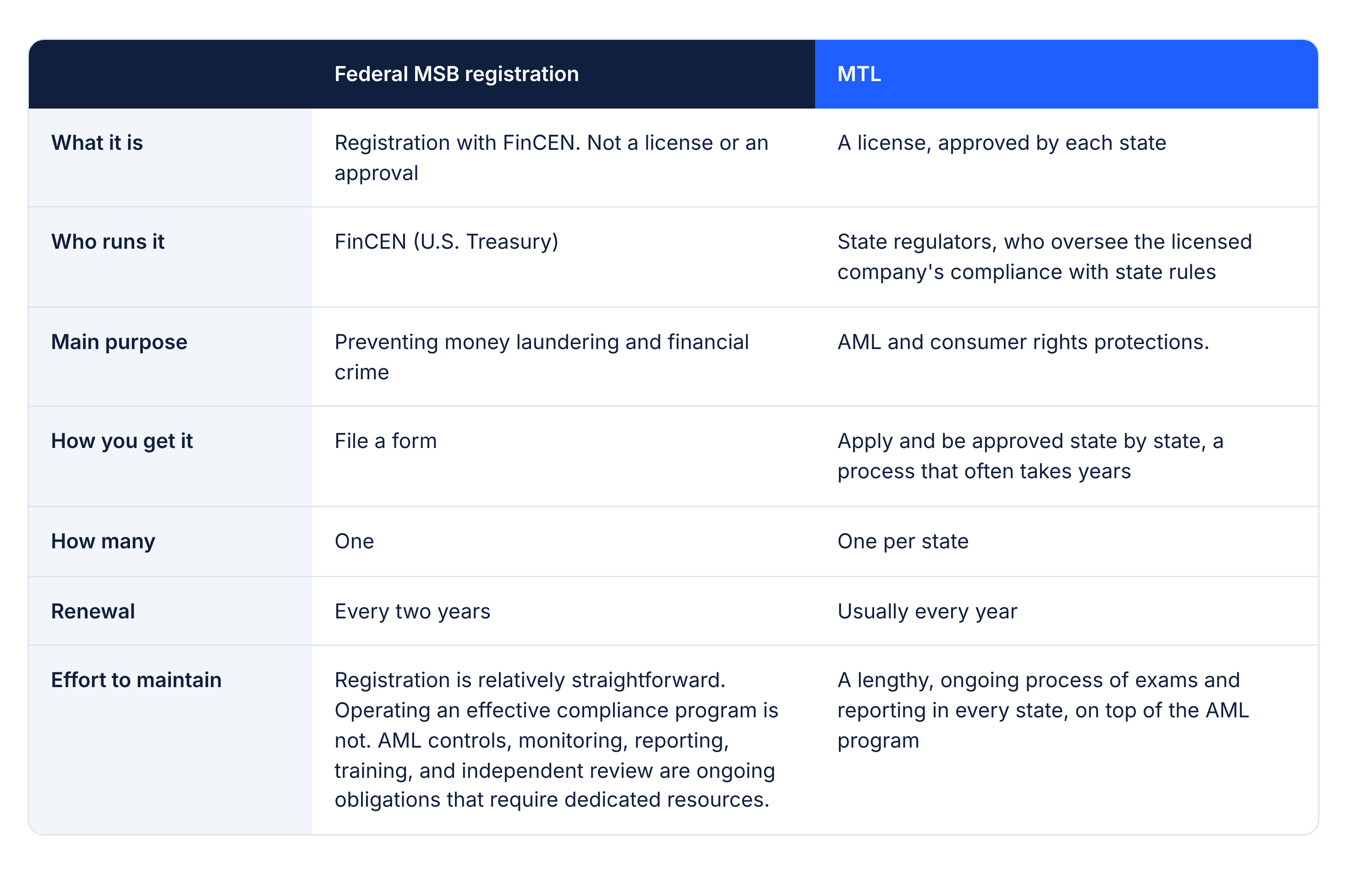
The short version: MSB registration is about who you are and what you report. MTLs are about showing regulators you have the expertise, controls, and consumer protections in place to hold and move other people’s money responsibly.
Why they matter
They protect the people whose money is moving. Between the moment a customer sends funds and the moment the recipient gets them, someone is holding that money. Bonding and permissible investment rules exist so those funds are still there if the company holding them runs into insolvency.
They keep bad money out. Anti money laundering programs, reporting, and recordkeeping make it harder to use payment products for fraud or crime.
They decide what you can build. Money transmission means receiving money from one person and sending it to another or storing another person’s money. If your product sits in the middle of that, holding or moving funds that aren’t yours, it is likely money transmission and has to be carried out by a bank or a licensed money transmitter. Some common cases:
- A customer pays a provider through your app (bill pay): Usually money transmission if you collect the customer’s funds and then pass them to the biller. Many states exempt it if you act as the biller’s agent, under a contract with the biller, and the customer’s bill counts as paid once you receive the funds.
- A provider pays out to its own customer (refunds, insurance claims, payroll): Usually not money transmission when a company disburses its own money. It can become money transmission when a platform pays out other companies’ money, for example gig payouts funded by a client as the provider is storing other companies’ money prior to payout.
- A user holds a balance in your app: Usually money transmission, since you hold their funds until they spend or withdraw them.
- One user pays another (P2P): Money transmission. You receive funds from one person and deliver them to another.
The details vary by state and by how funds actually flow through your product, so these are starting points, not a substitute for legal review.
Getting it wrong is expensive. Transmitting money without a license can bring state and federal penalties, and it can cost you your bank and network relationships.
Do you need your own licenses?
Not always. A company that wants to move money generally has three options:
- Get licensed yourself. You control everything, but you take on the cost, the multi year timeline, and a staffed compliance team.
- Work through a sponsor bank. Most banks are exempt from state money transmitter licensing, but that exemption belongs to the bank, not to the fintech working with it. A program run with a sponsor bank may not need its own MTLs, depending on how it is structured and who controls the funds. If the fintech receives or holds customer money itself, it may still need to be licensed. The bank also decides which products and use cases it will support. States have become more aggressive in enforcing state law for unlicensed companies that advertise or hold themselves out as a money transmitter, even if the company does not receive or store customer funds.
- Use a licensed money transmitter’s service. Here the licensed company is the one doing the money transmission. It takes custody of the funds, has the relationship with the end user for that activity, runs the compliance program, and answers to regulators. Your product connects to that service. You are not operating under someone else’s license.
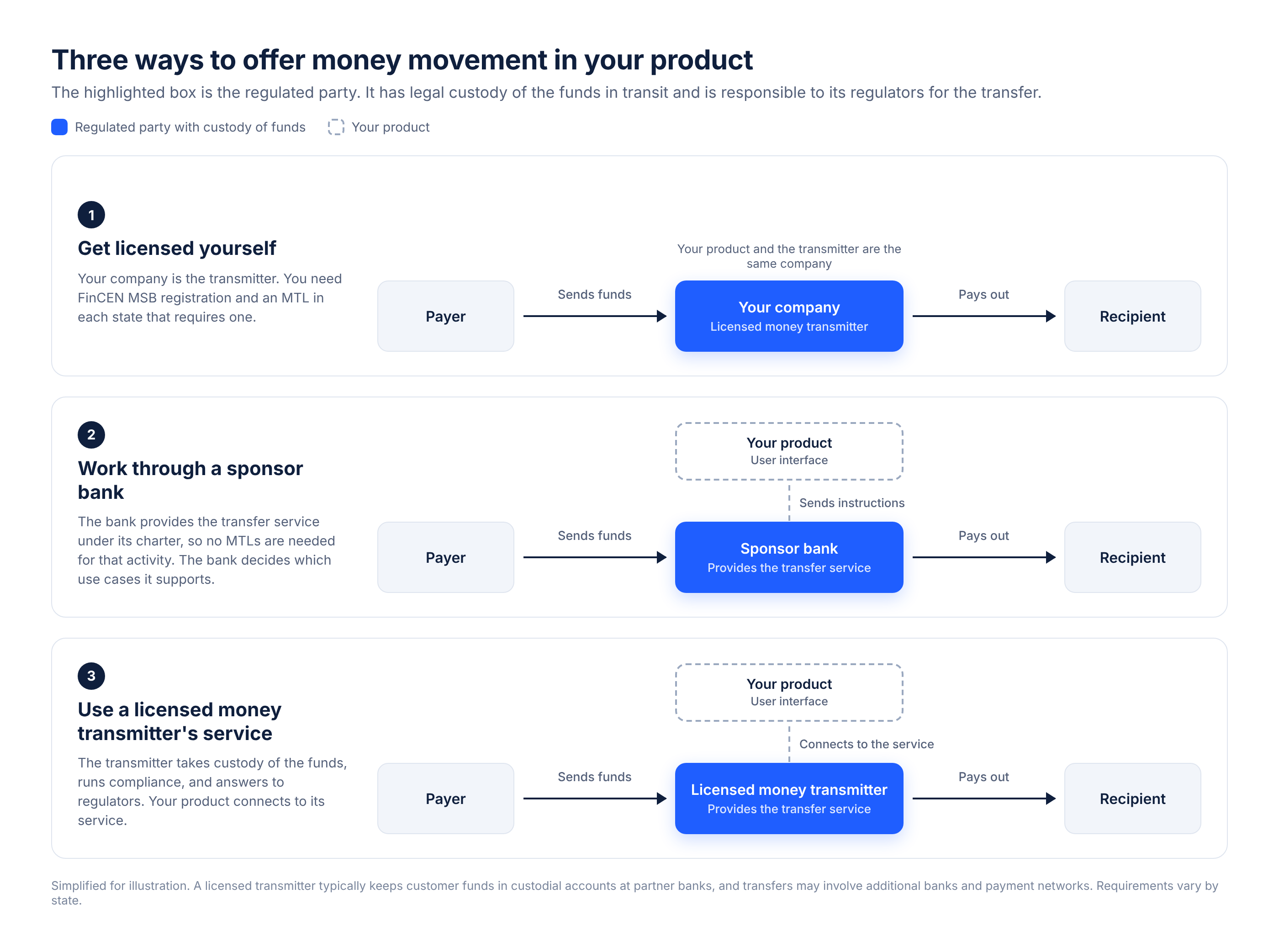
Many companies end up using a mix. Which one fits depends on what you are building, how fast you need to launch, and how much of the compliance work you want to own. This is a question for your legal counsel, since the answer turns on the details of how funds flow through your product.
Where TabaPay fits
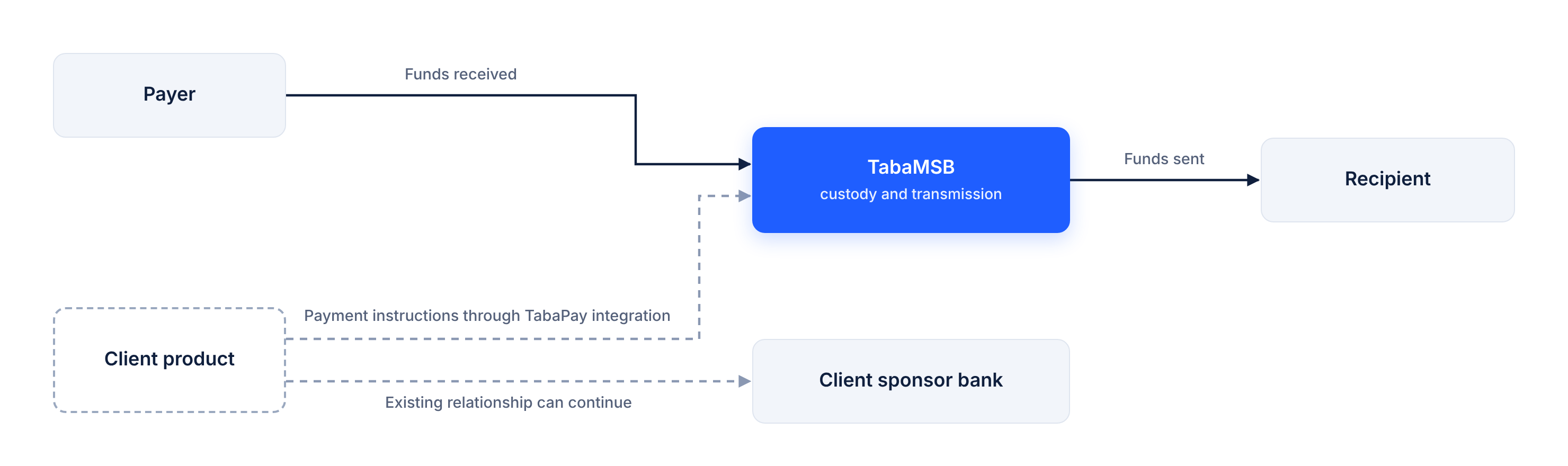
TabaPay works with 20+ partner banks today. TabaMSB is the TabaPay entity that provides money transmission. When TabaMSB moves funds, TabaMSB is the transmitter: it takes custody of the funds in its own For Benefit Of (FBO) account at a partner bank, runs the compliance program, and answers to regulators for that activity. Clients connect to that service through the same TabaPay integration and can keep the sponsor banks they already work with.
If you are working out which model fits your product, talk to our team!
Sources
- FinCEN: Money Services Business (MSB) Registration
- CSBS: MTMA Legislative Update, April 2026
- Money Transmitter Licenses in the US: Fifty Licenses Instead of One